
 Luca Giorgio
What to take away
- Choose one main job for your website.
- Gather accurate information and the materials you already have.
- Agree who decides, who contributes and who keeps things current.
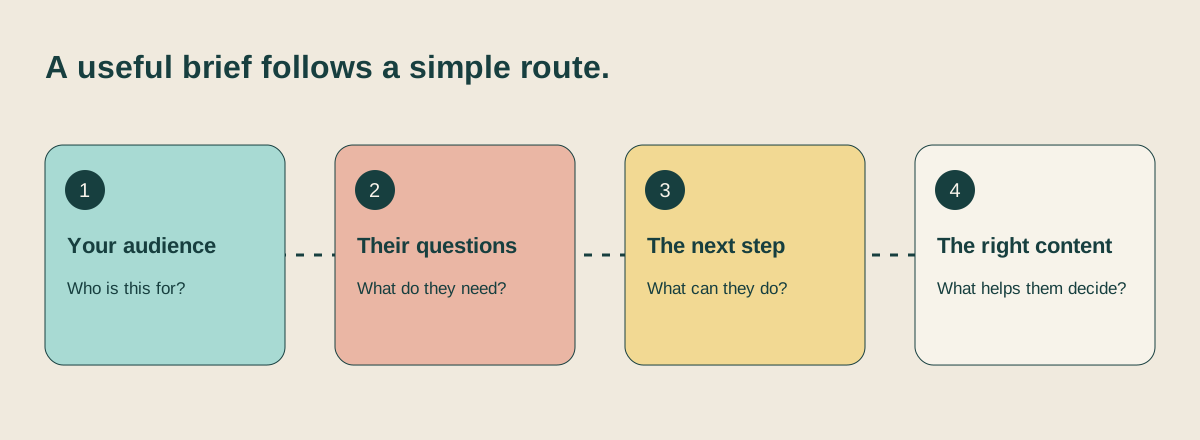
A website project begins before the first layout. The useful early work is deciding who the site should help, what those people need to know, and what your business can realistically keep up to date.
You do not need a perfect brief. I would rather start with honest notes, a few unanswered questions and someone who can make decisions than a polished document that avoids the difficult choices.
Here is what I suggest gathering before we begin.
1. A clear job for the website
Write one sentence describing the main action you want a visitor to take. For example: “Help someone understand our accommodation and send a booking enquiry with their preferred dates.”
Then describe the person taking that action. Are they already familiar with you? Are they comparing options? What might make them hesitate?
Choose one primary action and a small number of supporting actions. A restaurant might prioritise table bookings while also making it easy to check the menu, find directions or ask about a private event. This gives us a basis for deciding what belongs on the homepage.
2. The facts people need to make a decision
Gather the information you repeatedly share in conversations, messages and emails. Those recurring questions often reveal useful website content.
Prepare a simple document containing:
- Your services, products or experiences, described plainly.
- The locations or areas you serve.
- Prices, starting points or an explanation of how quotes work, where useful.
- Contact details, opening hours and booking arrangements.
- Important practical details that might affect someone's decision.
- Questions people ask before they buy, book or visit.
Mark anything uncertain. “Seasonal opening hours to confirm” is useful information for a project team. An unmarked placeholder can easily become an accidental promise.
3. The material you already have
Create one shared folder for logos, photographs, existing copy and brand guidance. Keep original image files where possible, and identify which materials you have permission to publish.
Separate current material from older versions. Add a short note when an image needs context: the name of a room, the season a dish is served, or the location shown.
You do not need to write every page yourself. Rough notes and a conversation can be a better starting point for content development. What matters is access to accurate information and to the person who understands the business.
A useful reference comes with a reason: “The rooms are easy to compare” gives a designer something to work with.
4. A few references, with reasons
Choose two or three websites you find useful and explain what you like about each. “The rooms are easy to compare” tells me more than “I like the style.”
Include anything you want to avoid. Perhaps your current site hides contact details, feels too formal, or relies on photographs that no longer reflect the place. Specific observations help connect design choices to actual needs.
5. The practical boundaries
Agree who will approve the work, who will supply information and who will maintain the site. If several people need to review it, choose one person to bring their feedback together.
Share your preferred launch date, budget range and any fixed commitments. List the systems involved, such as your domain, hosting, email, booking platform or existing website. Record who manages them; arrange access securely when it is needed.
A useful starting brief
Before a first conversation, try completing these five lines:
- This website should help people to…
- Our most important audience is…
- The questions they need answered are…
- We already have…
- We still need help with…
That is enough to start a productive discussion. From there, I can help turn the raw material into a clear scope, a content plan and a sensible sequence for design and development.